
Diabetes affects millions worldwide—and its silent impact is only accelerating as our lifestyles change and populations age. The good news? Today’s diagnostic technology gives us more insight than ever before. At the heart of diabetes management lies an evolving suite of blood tests and monitoring tools, each contributing a vital piece to the puzzle of optimal health. In this article, we’ll clarify the roles of A1C and other diabetes markers, explain the science behind these tools, dispel common misconceptions, and help you chart a more confident journey if you’re living with (or aiming to prevent) diabetes.
What Is A1C and Why Is It So Important?
A1C, or Hemoglobin A1C, is the cornerstone of diabetes diagnosis and long-term glucose management. This simple blood test reflects your average blood sugar over the past 2-3 months—offering a powerful snapshot of your risk for complications and your success with treatment strategies.
Long-Term Indicator: A1C measures the percentage of hemoglobin in your red blood cells that’s coated with sugar (glycated). It is the "report card" of your glycemic control, unlike daily glucose readings, which can fluctuate depending on meals, stress, illness, or medications.
Predicts Complications: Multiple studies confirm that lowering A1C reduces the risk of eye, kidney, and nerve damage—the most feared microvascular complications of diabetes.
Tool for Assessment: Physicians adjust therapies, recommend lifestyle changes, and gauge progress primarily through A1C, tailoring care for the individual.
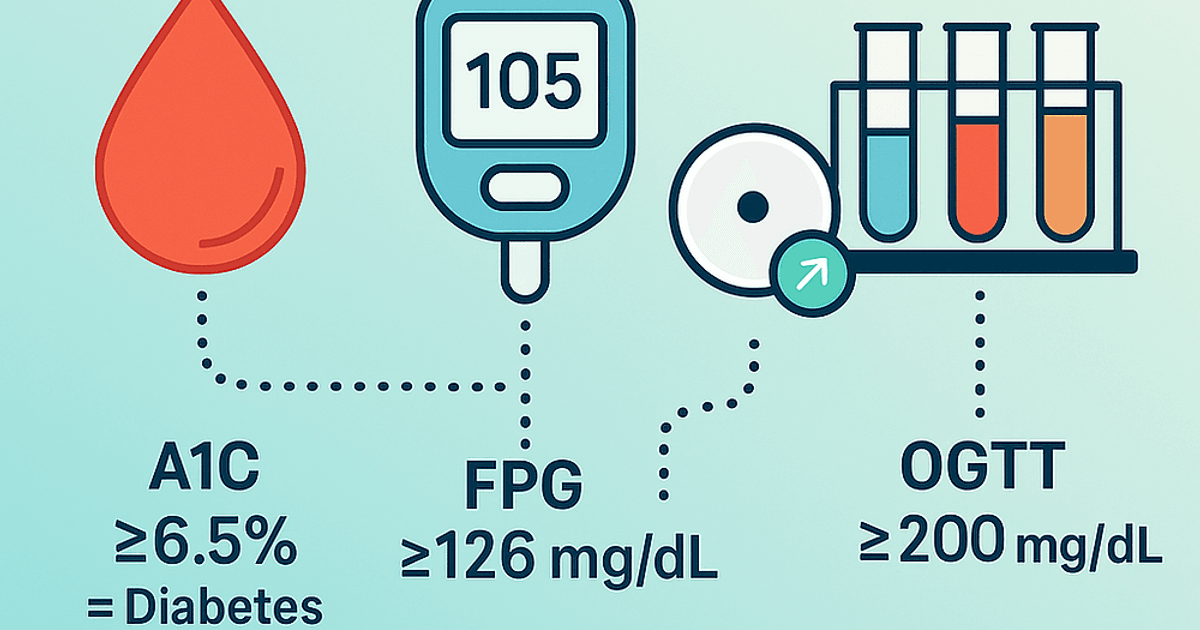
Screening and Early Action: A1C above 6.5% signals diabetes, while the “prediabetes” range (5.7 to 6.4%) is a red flag for early intervention.
Want to learn about lifestyle changes that can powerfully impact your A1C? See our expert guide on preventing and managing type 2 diabetes.
Understanding Key Diabetes Markers—Beyond A1C
Effective diabetes care relies on more than one test. Here’s a breakdown of essential markers:
Fasting Plasma Glucose (FPG)
Measures your blood sugar after fasting overnight. A reading of 126 mg/dL or higher (on two occasions) indicates diabetes. It’s convenient but captures just a “moment in time,” missing hidden fluctuations.
Oral Glucose Tolerance Test (OGTT)
After a night of fasting, you drink a sugary beverage, and your blood sugar is measured at intervals. A result of 200 mg/dL or above at two hours confirms diabetes. OGTT is especially important for uncovering early, subtle issues like prediabetes or gestational diabetes but can be more cumbersome.
Random Plasma Glucose
Used when classic symptoms (thirst, frequent urination, unintentional weight loss) are present—a result at or above 200 mg/dL may confirm diagnosis.
C-Peptide
Assesses how much insulin your pancreas is making, which helps distinguish between type 1 (usually very low or absent) and type 2 diabetes.
Fructosamine and Glycated Albumin
These tests reflect average sugar levels over 2-3 weeks (shorter than A1C), helpful if A1C results are likely skewed—such as when someone has anemia or recent blood loss.
For more on the significance of different blood tests and their meaning for your health, review our guide on understanding your lab results.
Comparing A1C, FPG, and OGTT: Which Test Is Right for You?
A1C: The “gold standard” for monitoring; requires no fasting.
FPG: Useful, but limited by day-to-day fluctuations and fasting.
OGTT: Best for revealing hidden glucose issues (especially in prediabetes or pregnancy), but less practical for regular use.
Diagnosis can be made by any of these (as defined by major guidelines):
A1C ≥6.5%
FPG ≥126 mg/dL
2-hour OGTT ≥200 mg/dL
Your doctor will select the right combination based on your medical history, symptoms, and risk factors.
What Factors Can Affect Your A1C Accuracy?
A1C is powerful, but it’s not a perfect tool in all circumstances. Several factors can skew results, such as:
Anemia or Hemoglobin Variants: If you have certain types of anemia, sickle cell disease, or thalassemia, your A1C may read falsely high or low.
Chronic Kidney Disease: Advanced kidney issues can distort A1C results.
Ethnic Differences: Research shows that people of African, Asian, or Mediterranean descent may have slightly higher (or lower) A1Cs regardless of actual blood sugar, which must be considered in diagnostic decisions.
Other Causes: Blood transfusions, certain drugs, intense physical stress, or rapid changes in health can affect accuracy.
If you’re curious about what your A1C means in the context of other lab numbers, or need a comprehensive explanation, check out what you should know about blood tests.
The Role of Continuous Glucose Monitoring (CGM): Seeing the Full Picture
The diabetes care landscape has transformed thanks to wearable technology and remote sensors. Continuous glucose monitors (CGMs) offer a real-time look at where your blood sugar is, where it’s trending, and how blood sugar responds to food or activity—all without repeated finger sticks.
Key Benefits:
Real-Time Data: Alerts you to high or low readings and trends, even while you sleep.
Time-In-Range (TIR): This metric reveals the percentage of time your blood sugar remains within the target range—an essential complement to A1C, as two people with the same A1C could have very different glucose patterns.
Reduced Hospitalizations: Research demonstrates lower A1Cs, fewer episodes of dangerous hypoglycemia, and improved quality of life.
Personalized Insights: CGM helps both you and your doctor fine-tune everything—from medication to meals to exercise routines.
To dive deeper into remote monitoring and how wearables are changing chronic care, see our post on the role of wearable technology and remote patient monitoring.
Additionally, for a physician’s perspective on CGMs’ practical impact, read The Rise of Continuous Glucose Monitors (CGMs) in Personalized Healthcare.
Recent Advances: The Future of Diabetes Biomarkers
Science continues to move forward, offering individuals new hope for more nuanced and effective disease management. Here are some promising developments:
1. 1,5-Anhydroglucitol (1,5-AG)
A sensitive marker for detecting rapid spikes in blood sugar, particularly useful for monitoring how well you handle meals and snacks.
2. Time-In-Range (TIR)
This concept, enabled by CGMs, gives a clearer day-to-day view of blood sugar control. More time spent in range is closely linked to fewer complications.
3. Artificial Pancreas/Automated Insulin Delivery
Cutting-edge devices use complex algorithms to manage blood sugar with minimal input, a game-changer for many adults struggling with brittle diabetes.
4. New Research—MicroRNAs, Adipokines, Nanobiosensors
These new markers are in the early stages, but could fundamentally change the way we personalize diabetes care, making it even more accurate and patient-centered.
To learn more about advances in weight and diabetes management, don’t miss our expert review: Digital Obesity Care and Metabolic Health.
Optimizing Your Diabetes Care Plan: Practical Strategies
With such a wide array of tests and tools at our disposal, what’s the best approach?
Partner With Your Physician: Individualized care yields the best results. If you’re unsure how your numbers fit together or how different options might benefit you, a personalized discussion is crucial.
Combine Markers for a Comprehensive View: Don’t rely on a single test. A1C, FPG, OGTT, and CGM each capture unique aspects of your metabolic health.
Stay Current With Technological Advances: Ask about new monitoring options, especially wearables or emerging biomarkers, at your annual exam.
Consider Your Unique Risks: If you have anemia, kidney disease, or come from a background where A1C may read high or low, let your doctor know—so your care stays accurate.
Annual checks and screenings play a vital role in staying ahead of chronic diseases. For a full perspective on what essential checks help you stay healthy, read about the importance of preventative care, annual exams, and vaccinations.
Why Dr. Viraj V. Tirmal's Concierge Practice Is Different
As an MDVIP-affiliated, solo concierge practice, we believe diabetes and chronic disease management is about far more than numbers. We focus on:
Personalized attention and accessible care—so patients never feel rushed, lost in a system, or unclear about their tests.
The latest monitoring tools & next-generation research—integrated into everyday practice.
Strong emphasis on prevention, patient education, and shared decision-making.
Ongoing support for lifestyle change and stress management (see our article on simple mindfulness for stress reduction).
If you want more personalized, attentive diabetes care—or you’re concerned about your risk—join our practice online at mdvip.com/virajtirmalmd or book a consultation here.
Questions? Call us at 240-389-1986, fax 833-449-5686, or email staff@tirmal-md.com.
You Might Also Like:
Preventing and Managing Type 2 Diabetes: An Expert’s Guide to Lifelong Health
The Rise of Continuous Glucose Monitors (CGMs) in Personalized Healthcare
Digital Obesity Care and Metabolic Health
Understanding Your Lab Results: A Doctor’s Guide to Blood Tests and Health Insights
What You Should Know About Blood Tests: A Comprehensive Guide for Patients and Caregivers
The Role of Wearable Technology and Remote Patient Monitoring in Modern Healthcare
Importance of Preventative Care: Annual Exams and Vaccinations
References
Clinical Use of Hemoglobin A1c to Improve Diabetes Management
The Importance of Knowing Your A1C for Better Health
The A1C Test & Diabetes - NIDDK
Laboratory Testing for Diabetes Diagnosis and Management
Glucose tolerance test - Wikipedia
Diagnostic Test for Diabetes | The Medical City
Update on biomarkers of glycemic control - PMC
Comparison of diagnostic accuracy for diabetes diagnosis - Frontiers
Diabetes & Prediabetes Tests - NIDDK
Definition, Classification and Diagnosis of Diabetes, Prediabetes ...
The A1C Test and Patients with Chronic Kidney Disease - DaVita
Factors that Interfere with HbA1c Test Results - NGSP.org
The effect of different types of anemia on HbA1c levels in non ...
HbA1c Performance in African Descent Populations in the United ...
The Discrepancy Between Hemoglobin A1c and Glucose ... - NIH
Continuous Glucose Monitoring | Diabetes Care
Initiating continuous glucose monitoring is associated with ...
7. Diabetes Technology: Standards of Care in Diabetes—2025
1,5-Anhydroglucitol and Glycemic Control in Diabetes Management